What a $100 Website Can (and Can’t) Do for Your Small Business
A low-cost starter website can win you real customers — if you know what it is for. Here is what a $100 site should include, what it cannot do, and when it is time to upgrade.
 pasindukw
· 7 min read

In this article
- Why a small business still needs its own website
- What a $100 website should include
- What a $100 website cannot do
- The hidden questions to ask before you pay
- How to prepare so your $100 goes further
- Getting results from a starter website
- When it is time to upgrade
- Common mistakes to avoid
- The bottom line
When a small business owner hears “website for $100”, two reactions are common. The first is suspicion: what is the catch? The second is the opposite: if a website only costs $100, why would anyone pay more? Both reactions miss the point. A low-cost starter website is a tool with a specific job. Used for that job, it can bring in real enquiries within weeks. Asked to do something else, it will disappoint.
This guide explains, honestly, what a $100 website can do for a small business, what it cannot do, how to prepare so you get the most from it, and the signs that it is time to upgrade. We run a limited-time $100 Starter Website package ourselves, so we will use it as the example — but the advice applies wherever you buy.
Why a small business still needs its own website
Social media pages and marketplace listings are useful, but you do not control them. Algorithms change, accounts get restricted, and your page looks exactly like every competitor’s. Your own website is the one place online where you decide what customers see first.
A simple website also answers the questions customers ask before they call:
- Are you real? A professional site with your name, location and contact details builds trust instantly.
- Do you do what I need? A clear list of services saves both of you time.
- How do I reach you? A phone button, WhatsApp link and contact form remove every excuse not to get in touch.
- Where are you? A map and service area tell local customers you can help them.
None of those needs an expensive custom build. That is exactly the gap a starter website fills.
What a $100 website should include
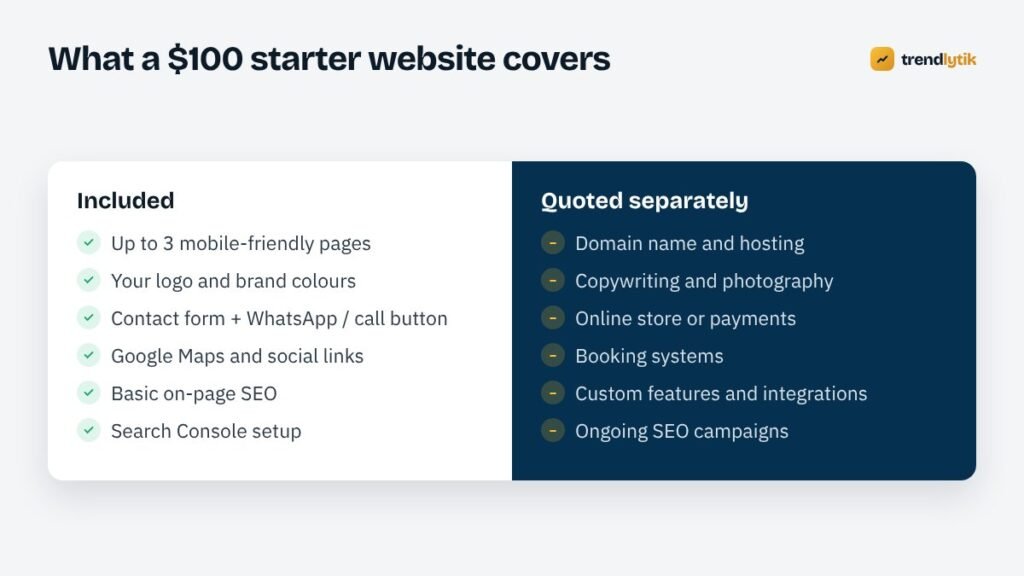
A starter package is defined by its limits, so read the scope carefully. A fair $100 website should give you:
- A few well-organised pages. Typically a home page, an about page and a contact page. The home page does most of the work: a headline that says what you do, a short list of services, a reason to choose you and a call to action.
- A mobile-friendly design. Most local searches happen on phones. Buttons must be big enough to tap, text large enough to read and pages light enough to load on a mobile connection.
- Your brand, not a template’s. Your logo, your colours and your photos — even simple ones — make the site feel like your business rather than a demo.
- Easy ways to contact you. A contact form, a click-to-call button and, for many businesses, a WhatsApp button.
- Basic on-page SEO. Sensible page titles, meta descriptions, headings and image alt text, plus Google Search Console so you can see how people find you.
- Ownership. The domain should be in your name and you should receive the administrator login.
What a $100 website cannot do
Being clear about limits protects you from disappointment. At this price you should not expect:
Custom design and development
A starter site is usually built quickly on a proven, lightweight foundation. It will look professional, but it will not be designed from scratch around your brand the way a custom theme is. If your website is your main sales tool in a competitive market, that difference matters.
An online store or complex features
Product catalogues, payments, stock management, appointment booking, membership areas and integrations with other software each add real work. They are rarely part of any starter package — and if they are, ask what happens when something breaks.
Content writing and photography
Good words and photos sell. A starter price assumes you provide them. If you do not have time to write, budget for a copywriter or ask for a quote.
Ongoing SEO results
Basic on-page SEO makes your site understandable to search engines. Ranking for competitive terms such as “plumber in Colombo” or “wedding cakes Dubai” requires more pages, useful content, reviews and time. A starter site is the foundation, not the whole campaign.
Domain and hosting
Almost every low-cost offer excludes these, and that is reasonable: they are yearly costs that you should own directly. Expect a modest annual fee for each. A good developer will help you choose and connect them.
The hidden questions to ask before you pay
Cheap does not have to mean risky. Before you commit to any starter package, ask:
- Who owns the domain? It must be registered in your name. A domain registered to the developer can become a hostage in a dispute.
- Will I get the admin login? You should be able to log in and update text and photos yourself.
- What happens after launch? Find out what support is included and what updates cost.
- How many revisions are included? One round is common at this price. Make the most of it by sending all your feedback at once.
- Is there a monthly fee? Some “cheap” sites are rented. That can be fine, but compare the total over two or three years.
- What are the conditions? Limited-time offers usually have them. Read them before you order, not after.
Our own conditions are written out in full on the package card — new clients, one site per business, content supplied by you and so on. That is how it should be everywhere.
How to prepare so your $100 goes further
The single biggest factor in how good a starter website turns out is what you bring to it. Before work starts, gather:
- Your logo in the best quality you have, ideally a PNG or SVG with a transparent background.
- Five to ten photos of your work, your premises, your team or your products. Real photos beat stock images for trust.
- A short description of each service, in plain language: what it is, who it is for and why customers choose you.
- Your contact details: phone, WhatsApp, email, address or service area and opening hours.
- Two or three websites you like, so the designer understands your taste.
- Any reviews or testimonials customers have already given you, with permission to use them.
Write the way you speak to customers. “We fix fridges, washing machines and air conditioners across Colombo, usually the same day” is better than a paragraph of marketing language.
Getting results from a starter website
A website on its own is like a shop on a quiet street. These low-cost steps bring visitors to it:
Connect it to Google Business Profile
For local businesses this is the most important free step. Add your website link, accurate hours, categories and photos to your Google Business Profile, and ask happy customers for reviews. Our guide to local SEO for service businesses walks through it.
Put the link everywhere
Social media bios, WhatsApp Business profile, email signatures, invoices, vehicle signage and printed flyers. Every mention is a reminder.
Make contacting you effortless
Check that every button works on your own phone. Reply to enquiries quickly — speed often wins the job.
Keep it fresh
Update photos, add new services and refresh your opening hours. A site that looks abandoned loses trust.
When it is time to upgrade
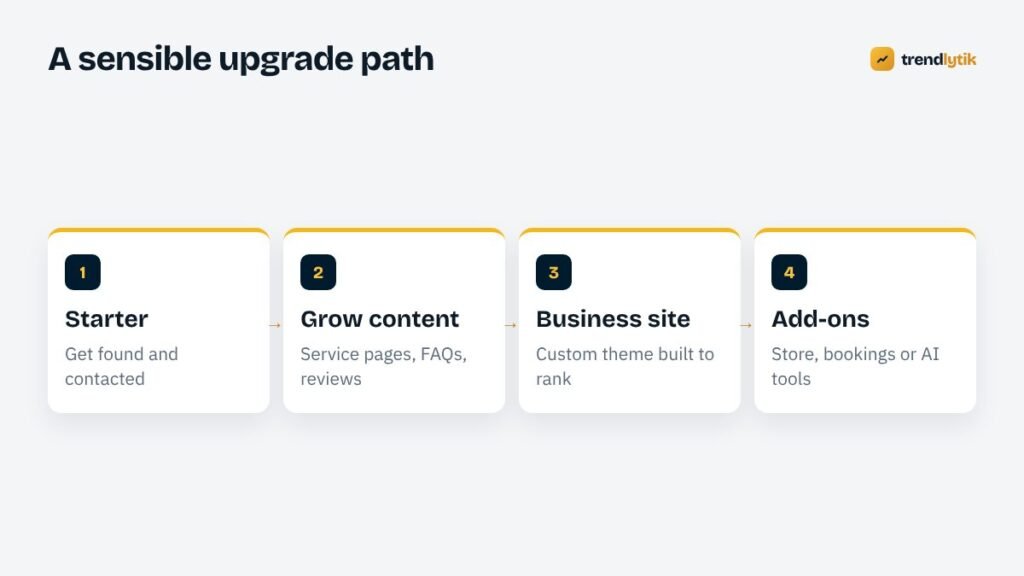
A starter website is designed to be outgrown. Here are the signs you are ready for more:
- You want to rank for competitive searches. That usually needs dedicated service pages, location pages that genuinely help customers, FAQs and regular articles — more than three pages can hold.
- You want to sell online. A proper WooCommerce store handles products, payments, shipping and customer emails.
- You are spending hours on admin. Online booking, automated reminders or AI tools can give that time back.
- Your brand has grown. A custom WordPress theme reflects who you are now and is built for speed and conversion.
- Your site is slow or hard to edit. If small changes need a developer every time, the foundation is holding you back.
Because a starter site built on WordPress keeps your content, upgrading does not mean starting over. Your pages, images and search history move with you.
Common mistakes to avoid
- Waiting for perfect content. Launch with clear, honest text and improve it later. A good site live this month beats a perfect site next year.
- Hiding the phone number. Put it in the header and make it tappable on mobile.
- Using someone else’s photos. Images copied from other websites can lead to copyright claims. Use your own photos or properly licensed stock.
- Forgetting the basics after launch. Renew the domain on time, keep WordPress updated and check that the contact form still delivers emails.
The bottom line
A $100 website is not a shortcut to page one of Google, and it is not a replacement for a custom-built sales machine. It is something simpler and, for many small businesses, more urgent: a credible, mobile-friendly home on the internet that you own, which makes it easy for customers to contact you.
If that is what your business needs right now, a starter website is one of the best-value investments you can make. If you need more, start with the conversation — a good developer will tell you honestly which package fits. You can see our current offer, including every condition, on the packages page, or send us your details for a recommendation.
Questions about this topic.
Is a $100 website good enough for a real business?
For a business that mainly needs to look credible and be easy to contact, yes. It gives you a professional home for your services, contact details and location. It is not designed for selling products online or running complex bookings.
Do I own a $100 website?
You should. Make sure the domain is registered in your name and that you receive the WordPress administrator login. With Trendlytik's starter package both are yours from day one.
Can a starter website rank on Google?
It can rank for your business name and for simple local searches, especially when paired with a well-maintained Google Business Profile. Competitive keywords usually need more pages and content over time.