Local SEO for Home Service Businesses: A Practical Guide
Plumbers, electricians, cleaners and appliance repair companies win most of their work from local search. This guide covers Google Business Profile, service pages, reviews, citations and schema.
 pasindukw
· 7 min read

In this article
- How local search works
- Pillar 1: Google Business Profile
- Pillar 2: A website built around your services
- Area pages: useful vs doorway
- Pillar 3: Reviews
- Pillar 4: Consistent citations
- Pillar 5: Technical SEO and schema
- Common local SEO mistakes
- Showing up in AI answers
- Measuring what matters
- A 30-day local SEO plan
When a washing machine floods the laundry or the air conditioner dies in the middle of summer, nobody browses ten pages of search results. They search “appliance repair near me”, look at the map, check a few reviews and call. For home service businesses, that moment decides most of the year’s revenue.
Local SEO is the work of making sure your business shows up in that moment — in the map results, in the regular results below them and, increasingly, in AI-generated answers. This guide covers what actually moves the needle, based on our work with home service companies in the United States, the UAE and Australia.
How local search works
For searches with local intent, Google typically shows a map with a handful of business listings — often called the local pack — above or among the regular results. Google has said local results are based mainly on three factors:
- Relevance — how well your business matches what the person searched for.
- Distance — how far you are from the searcher or the location in the search.
- Prominence — how well known and trusted your business is, which includes reviews, links and your overall web presence.
You cannot change distance. Everything in this guide is about relevance and prominence.
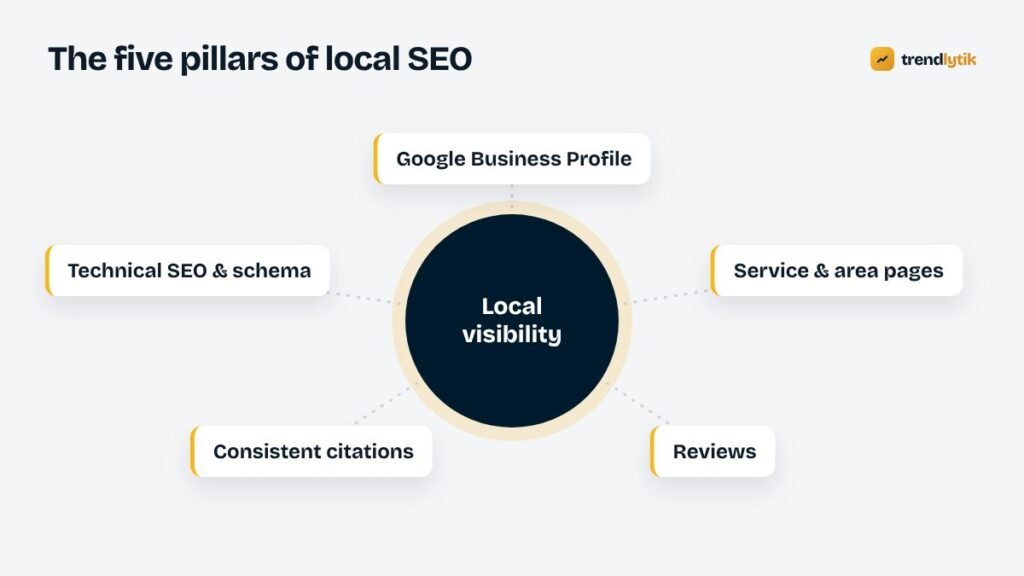
Pillar 1: Google Business Profile
Your Google Business Profile is the listing that appears in Maps and the local pack. For many service businesses it generates more calls than the website itself. Get these right:
- Primary category. Choose the most specific category that matches your core service. It is one of the strongest relevance signals. Add secondary categories only for services you genuinely offer.
- Service area. If you travel to customers and do not serve them at your premises, hide your address and list the areas you cover.
- Services and descriptions. List each service with a short, plain description.
- Hours. Keep them accurate, including holiday hours. Nothing loses a customer faster than calling a closed business that says it is open.
- Photos. Real photos of your team, vehicles and completed jobs. They build trust and show the profile is active.
- Website link. Link to your home page or the most relevant service page, and make sure that page loads quickly on mobile.
- Updates and questions. Post occasional updates and answer questions customers ask on the profile.
Use your real business name. Stuffing keywords or city names into the business name breaks Google’s guidelines and can get a listing suspended.
Pillar 2: A website built around your services
Your website gives Google — and customers — the detail a profile cannot. A strong home service website has:
One page per core service
“Refrigerator repair”, “washing machine repair” and “dryer repair” are different searches from different people. A dedicated page for each lets you explain the problems you fix, the brands you work on, your process and pricing approach, and answer the questions people ask. A single “Services” page with a bullet list cannot compete with that.
Clear service-area information
State the cities and neighbourhoods you cover in plain text, on the contact page and in the footer. If you create pages for specific areas, make each one genuinely useful — more on that below.
Proof
Photos of real jobs, short case notes (“Same-day fridge compressor replacement in Lake Oswego”), licences and certifications, guarantees and reviews. Proof is what turns a visitor into a caller.
Fast, obvious contact options
A tappable phone number in the header, a short form and — where it helps — online booking. For All About Repair we built a booking calendar that starts with the customer’s address, so only bookable time slots in the service area are shown.
Area pages: useful vs doorway

Many businesses create a page for every town they serve, with the same text and the town name swapped. Google’s spam policies call these doorway pages, and they can drag down the whole site.
An area page is worth creating when you can make it genuinely different and useful: jobs you have completed there, photos, typical response times, local considerations (older housing stock, hard water, apartment access rules) and reviews from customers in that area. If you cannot write that, list the area on your main service page instead.
Pillar 3: Reviews
Reviews influence both rankings and whether people call. Build a simple routine:
- Ask every satisfied customer at the end of the job, while they are happy.
- Make it easy with a short link or QR code that opens the review form directly.
- Follow up once by text or email a day later.
- Reply to every review — thank the positive ones, and respond calmly and helpfully to negative ones.
Stay on the right side of the rules. Google prohibits offering incentives for reviews and selectively asking only happy customers while steering unhappy ones elsewhere (“review gating”). In the United States, the Federal Trade Commission’s rule on fake reviews also bans buying or fabricating reviews. Honest, steady reviews win in the long run.
Pillar 4: Consistent citations
Citations are mentions of your business name, address and phone number — often shortened to NAP — on other sites: directories, industry associations, local chambers of commerce, maps apps and social profiles.
- Use exactly the same business name, phone number and (if public) address everywhere.
- Claim the major platforms first: Google, Bing Places, Apple Business Connect and Facebook.
- Add relevant industry and local directories, but skip low-quality “submit to 500 directories” services.
- When you move or change phone numbers, update every listing.
Do not forget Bing. Bing Places takes minutes to set up, and Bing’s results feed other search engines and assistants.
Pillar 5: Technical SEO and schema
A few technical details help search engines connect your website to your business:
- LocalBusiness structured data on your website, using the most specific type available — for example
Plumber,Electrician,HVACBusinessorLocksmith— with your name, phone, URL, opening hours and service area. - Service schema on service pages, linked to the business as the provider.
- FAQ content that answers real customer questions.
- Fast mobile pages. Local searchers are on phones, often in a hurry. See our guide to Core Web Vitals.
- Clean structure: one H1 per page, descriptive titles that include the service and area, and internal links between related services.
Common local SEO mistakes
- Different phone numbers everywhere. Tracking numbers on every directory can confuse customers and search engines. If you use call tracking, keep your main number as the primary listing number.
- Listing services you do not offer to appear in more searches. It brings the wrong calls and damages reviews.
- Fake or duplicate listings for “virtual offices” in areas you want to rank in. Google removes them and can suspend the genuine listing too.
- A website that does not match the profile. If the profile says you serve three cities and the website mentions a fourth you left years ago, update it. Stale location content was one of the first things we fixed for a repair company client.
- Ignoring negative reviews. A calm, specific reply shows future customers how you handle problems — often more convincing than another five-star review.
- Slow, desktop-only websites. Most local searches happen on phones, frequently while the problem is happening.
Showing up in AI answers
Search engines and assistants increasingly answer “who can fix my dishwasher today?” with a short summary that names a few businesses. There is no separate trick for this. The same signals apply: a complete, accurate business profile; consistent details across the web; clear service pages that say what you do, where and for whom; genuine reviews that mention specific services; and structured data that spells it all out. Businesses that describe themselves clearly are easier to recommend.
Measuring what matters
Rankings fluctuate by location and device, so do not obsess over a single position. Track instead:
- Calls, direction requests and website clicks in Google Business Profile performance reports.
- Form submissions and bookings from your website.
- Search Console queries for your services and areas.
- Where new customers say they found you — ask every one.
A 30-day local SEO plan
- Week 1: Complete and correct your Google Business Profile, Bing Places and Apple Business Connect listings.
- Week 2: Create or improve one page for each core service, with photos and FAQs.
- Week 3: Start the review routine and reply to every existing review.
- Week 4: Fix citations, add LocalBusiness schema and test the site on your phone.
Then keep going: a new photo or job note each week, steady reviews and an occasional helpful article. Local SEO rewards consistency more than cleverness.
Need a website that does this properly? Our custom themes include LocalBusiness schema, service pages and fast mobile templates, and our technical SEO audits find what is holding an existing site back. Get in touch to talk it through.
Questions about this topic.
Do I need a physical address to appear in Google Maps?
No. Service-area businesses that visit customers can hide their address in Google Business Profile and list the areas they serve instead. You do need a real location where you can receive verification.
How many reviews do I need?
There is no magic number. A steady flow of recent, genuine reviews matters more than a big total from years ago. Make asking a routine part of finishing every job.
Should I create a page for every suburb?
Only where you can make each page genuinely useful with local detail. Near-identical pages with the town name swapped can be treated as doorway pages and do more harm than good.



2 comments